logo
About Us
China Quzhou Perfect Plastic Material Co., Ltd
Quzhou Perfect Plastic Material Co., Ltd
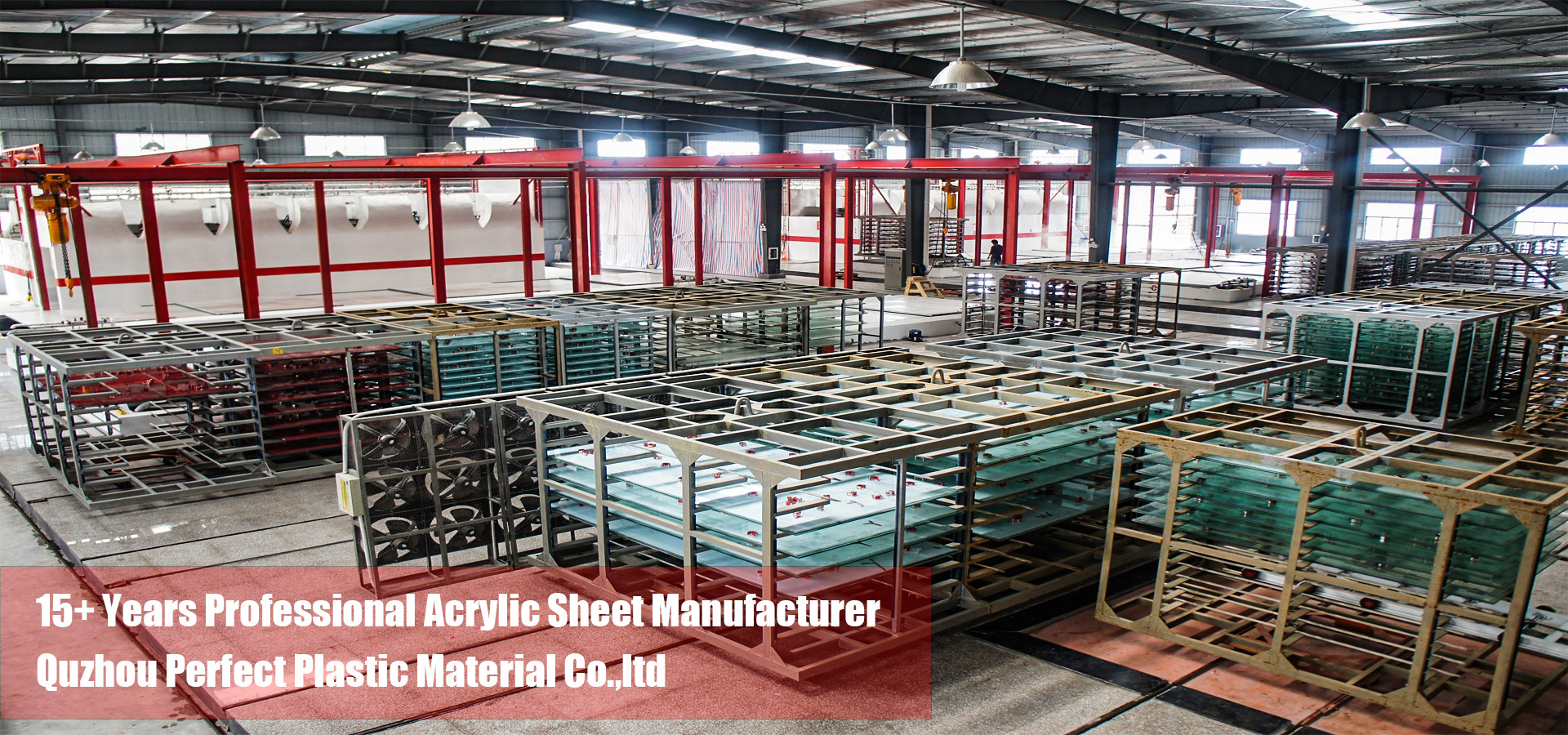
Quzhou Perfect Plastic Material Company was established in 2010. It is a professional cast acrylic sheet factory. We also sell acrylic products.
view more
request a quote
01
HIGH QUALITY
100% Virgin Raw Material. Company has strictly quality control system and professional test lab. Customers give high reputation to the quality of our goods.
02
HIGHLY COMPETITIVE PRICE
Good price to help our customer expand local market in their country and other countries. Competitive price.
03
MANUFACTURING
Advanced automatic machines, strictly process control system. We can manufacture all the Electrical terminals beyond your demand. Sourcing acrylic sheet factory.
04
100% SERVICE
Bulk and customized small packaging, FOB, CIF, DDU and DDP. Fast Response to customer. Effective OEM&ODM service. Good After-sales service.
company.img.alt
news_bg

latest news

Latest company news about Acrylic Industry Transformation: How University of Bath’s Recycling 
2026-05-21

Acrylic Industry Transformation: How University of Bath’s Recycling 

  The global acrylic (PMMA) industry has ushered in a revolutionary technological milestone in April 2026, as a research team from the University of Bath published an innovative low-temperature UV chemical recycling technology in Nature Communications. This cutting-edge solution fundamentally overcomes the long-standing drawbacks of traditional acrylic recycling, bringing unprecedented development opportunities for small and medium-sized acrylic manufacturers. As a local small-scale acrylic production and processing enterprise, Quzhou SM Company pays close attention to this industry technological progress and recognizes the huge market potential of circular acrylic materials.   According to official experimental data released by the University of Bath, the patented UV depolymerization technology operates in an oxygen-free environment at a temperature ranging from 120°C to 180°C. It achieves a polymer conversion rate of over 95% and a pure MMA monomer recovery rate of more than 70%. Compared with conventional thermal pyrolysis which requires 350°C to 400°C, this technology cuts energy consumption by two-thirds. Most importantly, the recycled MMA monomers maintain high purity, which can be repolymerized into virgin-grade PMMA products without quality degradation, realizing infinite closed-loop recycling of acrylic materials.   For decades, the acrylic industry has been trapped by recycling bottlenecks. Traditional mechanical recycling leads to yellowing, reduced light transmittance and unstable physical properties of recycled acrylic, restricting its application to low-end products. Conventional chemical recycling suffers from high energy consumption and high production costs. Statistically, the global annual consumption of acrylic materials exceeds 3 million metric tons, while the high-value recycling rate of waste PMMA remains below 18%. The University of Bath’s breakthrough effectively solves this industry pain point, filling the technical gap of low-cost and high-purity acrylic regeneration.    Against the backdrop of global carbon neutrality and China’s renewable resource policies, the entire acrylic industry is gradually shifting toward eco-friendly production. As a small local processor, [Your Company Name] currently focuses on the production of standard acrylic sheets and customized finished products. Facing intense low-end market competition with an average industry profit margin below 5%, the company maintains a stable and pragmatic business strategy. Instead of large-scale technological upgrades or heavy capital investment in the short term, the company closely observes the development of recycling technology. It moderately sorts and stores waste acrylic materials in daily production to adapt to the future trend of recycled materials.   From the perspective of the long-term industry prospect, the global acrylic high-end market is expanding rapidly. Optical-grade, medical-grade and photovoltaic weather-resistant acrylic products maintain an annual demand growth rate of 15% to 20%, with a gross profit margin exceeding 30%. Supported by the University of Bath’s technology, recycled acrylic can fully meet the production standards of high-value scenarios such as display screens, optical lenses and medical equipment. Meanwhile, China’s renewable PMMA policy offers a 90% VAT instant refund, reducing the production cost of recycled acrylic by approximately 800 RMB per ton. The dual advantages of technology and policy will greatly narrow the cost gap between recycled materials and virgin materials.   In conclusion, the University of Bath’s technological breakthrough marks the official arrival of the acrylic circular economy era. With superimposed benefits including mature recycling technology, favorable national policies and booming high-end market demand, the acrylic industry will bid farewell to vicious low-price competition and step into a new stage of green, high-value and sustainable development. As a vibrant local enterprise, [Your Company Name] will keep pace with global technological progress to create greater value for partners and contribute to the sustainable development of the global acrylic industry.
View More 
Latest company news about Acrylic Factory Keeps Pace with Global PMMA Trends and Automotive Lightweight Development
2026-05-11

Acrylic Factory Keeps Pace with Global PMMA Trends and Automotive Lightweight Development

  The global acrylic industry is evolving rapidly, driven by the rising demand for automotive lightweighting and sustainable plastic materials. More manufacturers are choosing modified PMMA for vehicle transparent parts, exterior trims and interior lighting components. As a small-scale acrylic factory with in-house production lines, Quzhou SM Company closely follows the latest industry trends and steadily optimizes its product quality to serve the growing automotive accessory market.   In 2026, the global PMMA industry continues to show clear development characteristics: traditional general-purpose acrylic products face homogeneous price competition, while high-performance modified acrylic for automobiles, medical treatment and optical use maintains stable premium prices. Leading international chemical enterprises including Röhm, Trinseo and Mitsubishi Chemical have successively realized industrialized chemical recycling of PMMA, greatly improving the recycling rate of waste acrylic and reducing carbon footprint by more than 90%. In the automotive sector, modified acrylic sheets have become one of the core lightweight materials. With a low density of 1.18g/cm³, 92% ultra-high light transmittance and excellent weather resistance, PMMA can reduce the weight of single automotive transparent parts by nearly 50%, effectively optimizing vehicle energy consumption and cruising range.   Against such industrial background, Quzhou SM operates as a flexible small-scale acrylic factory focusing on general acrylic deep processing. Unlike large chemical manufacturers that prioritize high-end automotive material mass production, the company currently concentrates on standard casting and extrusion acrylic products for diversified industries. Keeping a close eye on the automotive lightweight trend, the company maintains stable product quality and flexible production capacity, preparing itself for future market demands of modified acrylic materials.   For future development, the company has formulated a three-year industrial upgrading roadmap. Firstly, getting ready to make some product changes to adapt to higher temperature resistance and impact resistance requirements for new energy vehicles. Secondly, gradually launch low-carbon recyclable acrylic products, reserve physical recycling production capacity in line with global environmental trends, and prepare for the upcoming carbon tariff inspection of export orders. Thirdly, optimize factory intelligent production, reduce production cycle time, improve finished product yield, and maintain the flexible delivery advantage of small batches and multiple specifications.   Industry data shows that the global automotive PMMA market will maintain a compound annual growth rate of 4.2% from 2025 to 2032. Transparent automotive components and exterior semi-structural parts will become the fastest-growing subdivisions. The global demand for lightweight and environmentally friendly acrylic materials continues to rise. Small and medium-sized acrylic manufacturers with independent factories and customized processing capabilities will occupy an indispensable position in the industrial supply chain.   We clearly recognize that the acrylic industry is shifting from simple price competition to high-performance, low-carbon and customized competition. As a small factory, we do not blindly expand raw material capacity. Instead, we focus on polishing processing technology, optimizing automotive-grade formulas, and providing stable, cost-effective customized solutions for global downstream buyers. In the next three years, we will firmly focus on automotive lightweighting, continuously upgrade production technology, expand low-carbon recyclable product lines, and grow steadily alongside the global PMMA industry.
View More